Flatbed Truck
The idea here is that they offer this “flatbed dispatch” service – basically finding the freight for them and arguing rates with the broker and then booking the job and dealing with all of the necessary paperwork after that. For those who run just 1 truck (or 2), the benefit to running your own dispatch could be minimal amounts of time saved and additional revenue generated as compared to the effort required by you to perform these tasks yourself.
Paying for a flatbed can be significantly higher pay than working van. However, the goods are typically more awkward/oversized/heavy in nature. Nothing is going to get chained or strapped unless YOU strap them. Once you’ve had a few hours in the morning tarping lumber during some torrential downpours, I’m sure there’s very little desire for anyone else to have you refresh a load board or call up brokers either!
What is a flatbed?
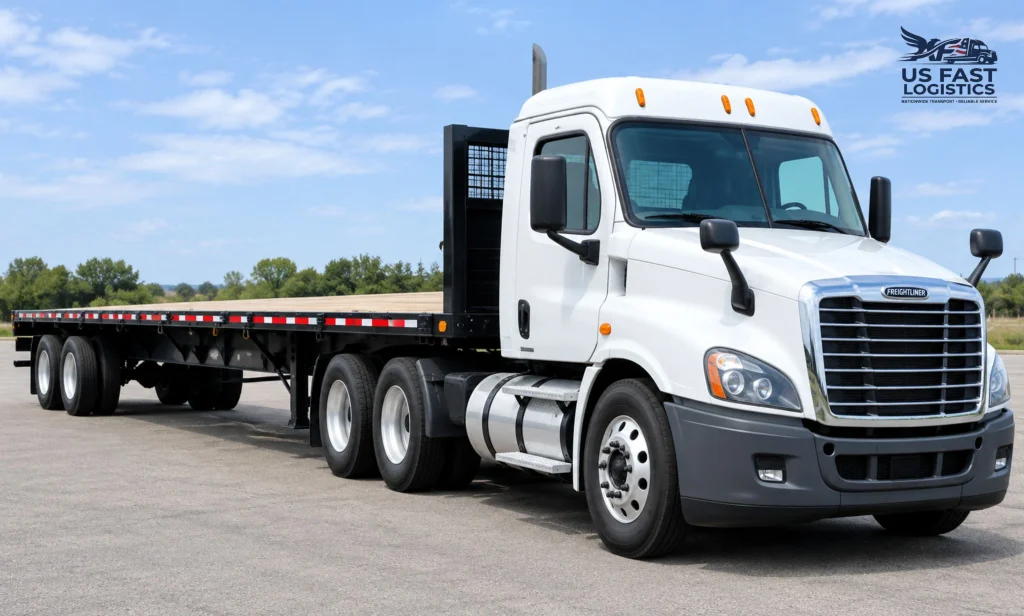
New drivers ask this, and so do shippers booking their first load: what is a flatbed? It’s an open cargo deck with no roof and no side walls. The freight sits on top and stays there because of chains, straps and binders.
And what is a flatbed truck? Any truck built around that open deck. Sometimes the deck is fixed to the truck’s own frame. On the highway it’s more often a tractor pulling a separate flatbed trailer. Either way, a forklift can load it from the side or the rear, and a crane can set freight down from above.
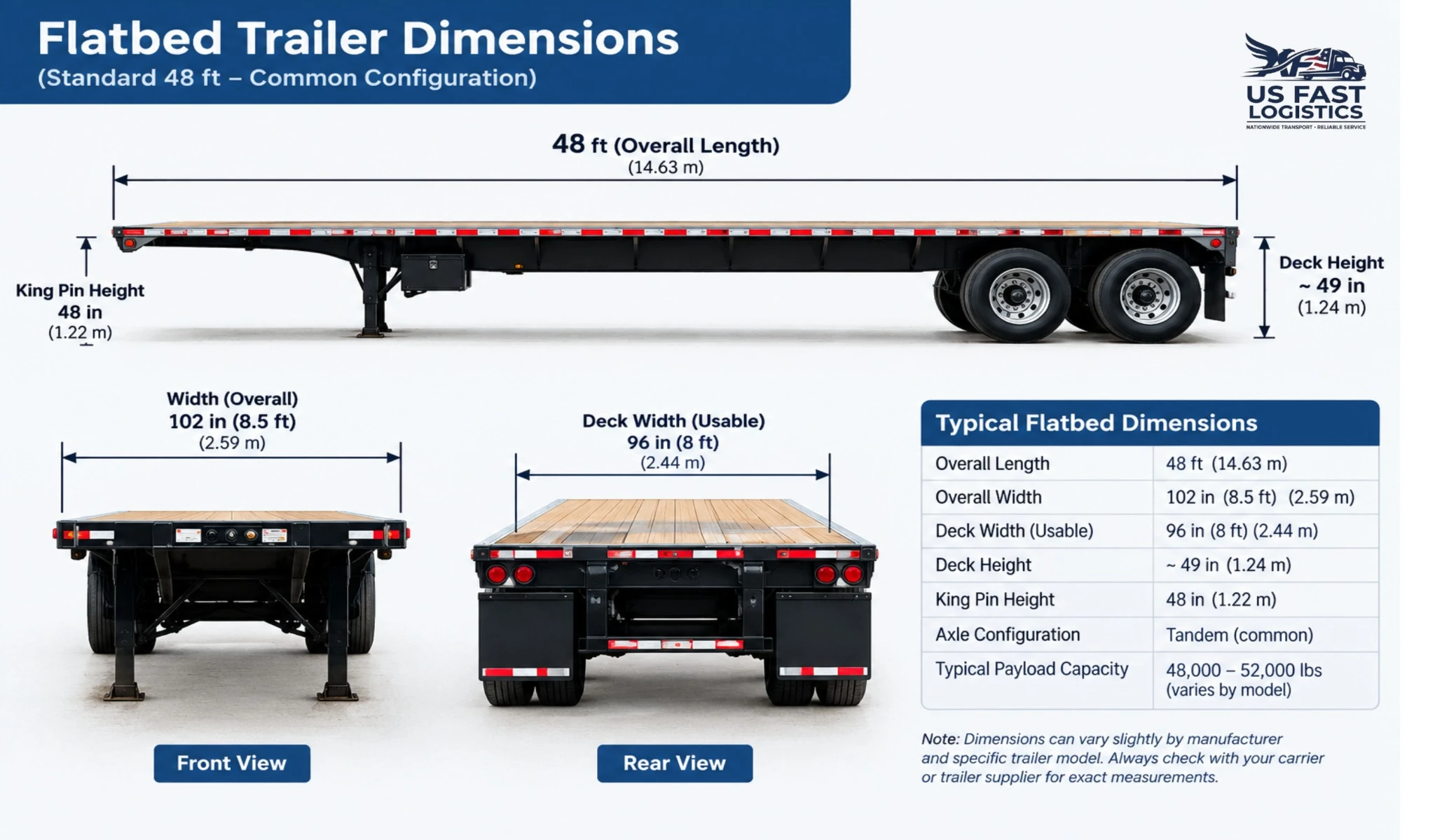
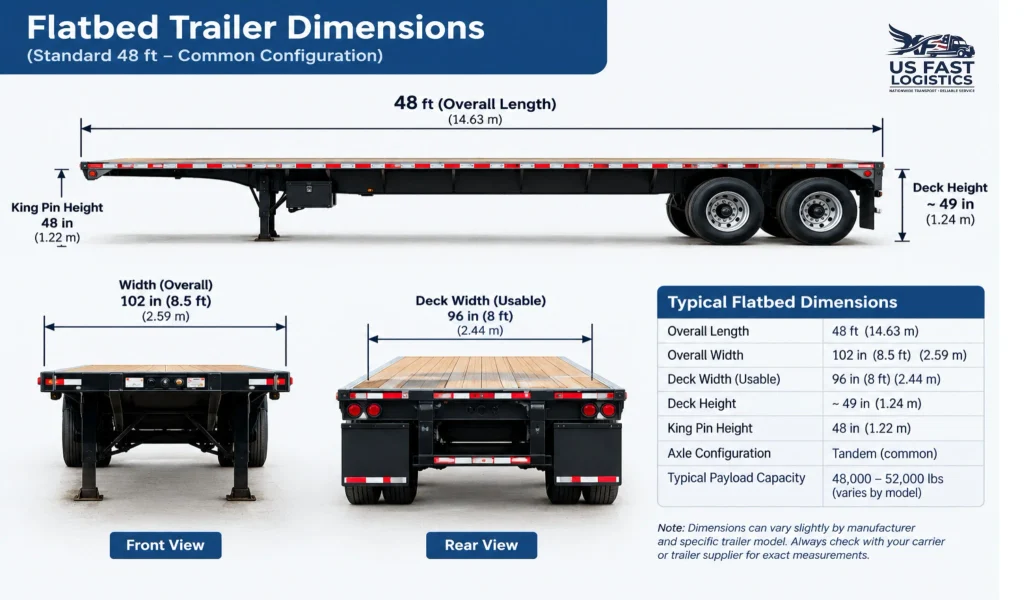
In the US, a standard flatbed trailer runs 48 or 53 feet long and 8 feet 6 inches wide, with the deck about 5 feet off the ground. A legal load tops out at roughly 48,000 pounds. Steel coils, lumber, pipe, machinery and building materials all ride on flatbeds because you’d never get them through the back doors of a dry van.
Flatbed equipment a dispatcher works with
Your equipment decides which loads you can take, so a dispatcher needs to know exactly what you pull. Shippers won’t always be precise about it. One asks for a flatbed trailer truck, the next wants a truck with a flatbed trailer, and both are describing a tractor with an open deck behind it.
| Equipment | What it is | Typical freight |
| Semi truck flatbed trailer | Class 8 tractor pulling a 48 or 53 ft open deck | Steel, lumber, pipe, palletized building materials |
| Step deck | Trailer flatbed with a lower main deck, about 3.5 ft high | Machinery and freight up to 10 ft tall |
| Flatbed straight truck | Deck mounted on the truck’s own frame, usually 20 to 26 ft | Local and regional deliveries, job site drops |
| Hotshot | Heavy duty pickup with a gooseneck flatbed, often 40 ft | Small, urgent or partial loads |
| Conestoga | Flatbed with a rolling tarp frame | Freight that needs cover but loads from the side |
| Flatbed with boxes | Deck fitted with underbody toolboxes | Any flatbed freight; the boxes hold chains, straps, binders and tarps |
Don’t skim past that last row. A flatbed with boxes has its securement gear on board, so the driver can say yes to a tarped load without stopping to borrow or buy anything. A good dispatcher will ask on day one what tarps, chains and straps you carry, and will only book what you can legally secure.
What a flatbed dispatch service does?
A dispatcher works for the carrier, never the shipper. Loads go under your own MC authority, and nothing is confirmed until you approve it. Day to day, the job covers:
Load search. Working DAT, Truckstop and direct broker contacts for freight that suits your trailer, your lanes and the home time you want.
Rate negotiation. Getting a fair line haul rate, then asking for tarp pay, extra stop pay and detention on top.
Broker checks. Pulling credit scores and days to pay before you haul for someone you don’t know.
Paperwork. Carrier packets, rate confirmations, insurance certificates, bills of lading.
Trip planning. Having the next load lined up before the current one is off the deck, so your flatbed truck isn’t sitting empty.
Problem solving. Getting the broker on the phone when a shipper runs late or a receiver refuses the freight.
Billing support. Sending invoices and documents to your factoring company, or straight to the broker.
People often confuse the two, but a dispatcher is not a freight broker. A broker has to hold its own FMCSA authority and a surety bond, and gets paid from the shipper’s side of the deal. You pay your dispatcher, and your truck should be the only thing they’re working for.
Why flatbed freight needs a specialist?
A dispatcher who only knows dry van will cost a flatbed carrier money. Four things make this freight different.
Securement rules. FMCSA’s cargo securement rules are in 49 CFR Part 393. The tiedowns on a load need a combined working load limit of at least half the cargo weight. Your dispatcher should know whether a load calls for chains or straps, and how many, before a rate ever gets quoted.
Tarping. Lumber, drywall and some steel have to be covered. It’s slow, physical work and it should be paid. Plenty of brokers will add a tarp fee, but only if somebody asks.
Oversize loads. Go wider than 8 feet 6 inches or heavier than 80,000 pounds gross and you need state permits. Some loads also need escorts and can only move in daylight. Miss a single permit and the truck sits at a scale house.
Seasons. Flatbed demand follows construction. Rates climb through spring and summer, then soften over winter in the northern states. A dispatcher who plans for that will have you running southern lanes when the north slows down.
What flatbed dispatch costs?
Most services take a percentage of each load’s gross, commonly 5% to 10%. Flatbed tends to sit toward the top of that range because each load takes more calls and more checking than van freight. Some services charge a flat weekly or per-load fee instead.
Take one load as an example. A 600 mile steel haul pays $2,100 plus a $100 tarp fee, so $2,200 gross. At 8%, the dispatcher’s cut is $176. If that dispatcher got the tarp fee added and pushed the rate up even 20 cents a mile, the service covered its own cost on that one trip.
Read the agreement before you sign it. Watch for forced dispatch, long contract terms and add-on charges for paperwork or factoring setup. A fair service lets you turn down any load and walk away on short notice.
How to choose a flatbed dispatcher?
Choose a dispatcher the way you’d choose a mechanic: by how well they know your equipment. Before you hand over a carrier packet, ask:
- Do you dispatch flatbeds every day? Have them tell you what they booked last week, and on which lanes.
- How many trucks does one dispatcher handle? Past five or six, your truck stops getting attention.
- Do I approve every load? The answer should be yes, with no penalty for saying no.
- How do you check brokers? They should be able to name the credit tools they use and the days-to-pay limit they stick to.
- What is in the fee? Make sure paperwork, detention claims and billing are covered.
- Can you work with my setup? A hotshot, a flatbed straight truck and a 53 ft step deck all need different freight.
Then do a trial. Two weeks will show you the rate per mile they bring in, how many empty miles you ran, and how quickly they pick up the phone.
Conclusion
A flatbed dispatch service is worth its fee when your rate per loaded mile goes up and your empty miles come down. Pick one that knows your trailer, lets you refuse any load, and shows you the rate confirmation every time.